Bayesian Linear Regression


Why Linear Regression: A Simple Statistical Golem
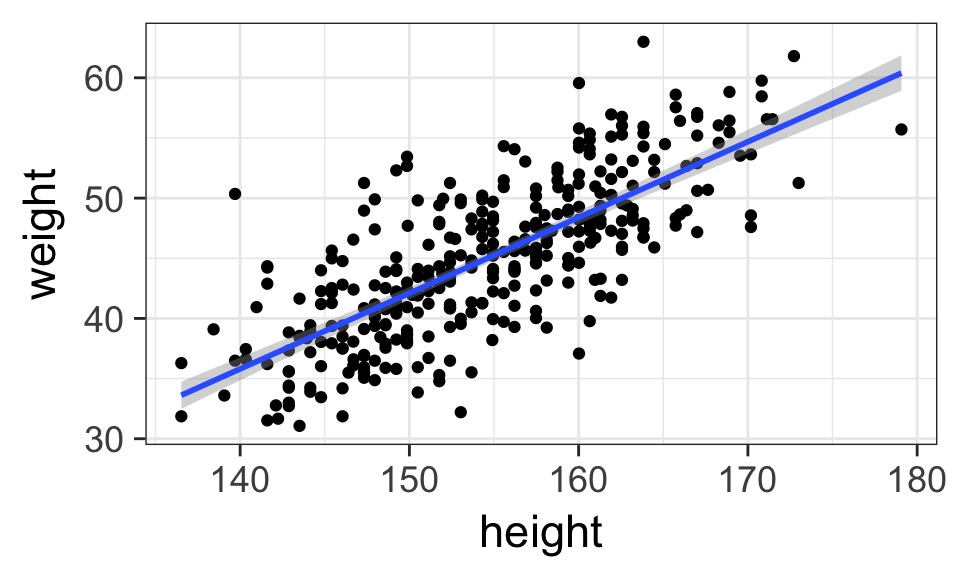
  • Describes association between predictor and response
  • Response is additive combination of predictor(s)
  • Constant variance

Why should we be wary of linear regression?

  • Approximate
  • Not mechanistic
  • Often deployed without thought
  • But, often very accurate

Why a Normal Error Distribution

  • Good descriptor of sum of many small errors
  • True for many different distributions

Why a Normal Error Distribution
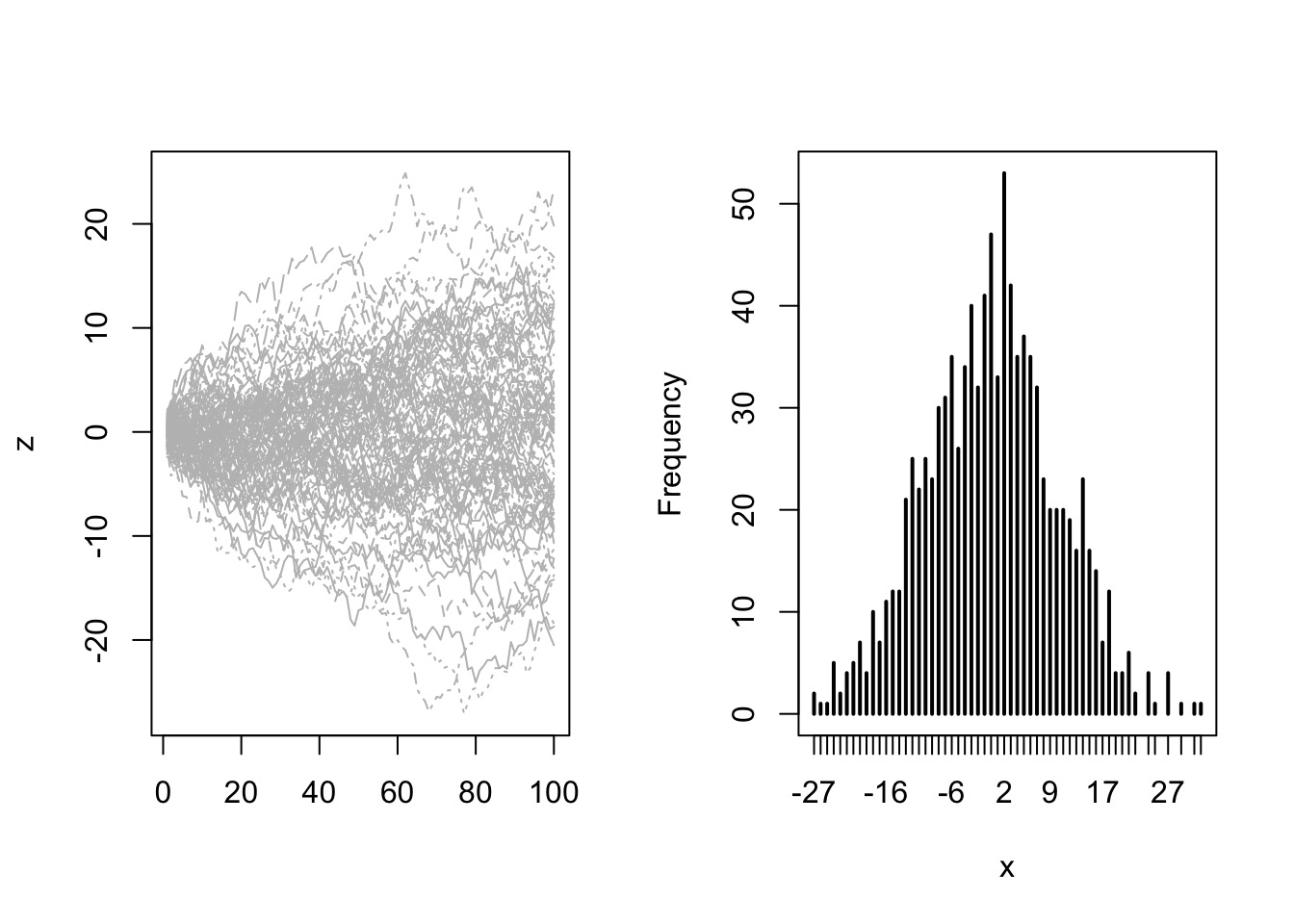
Flexible to Many distributions
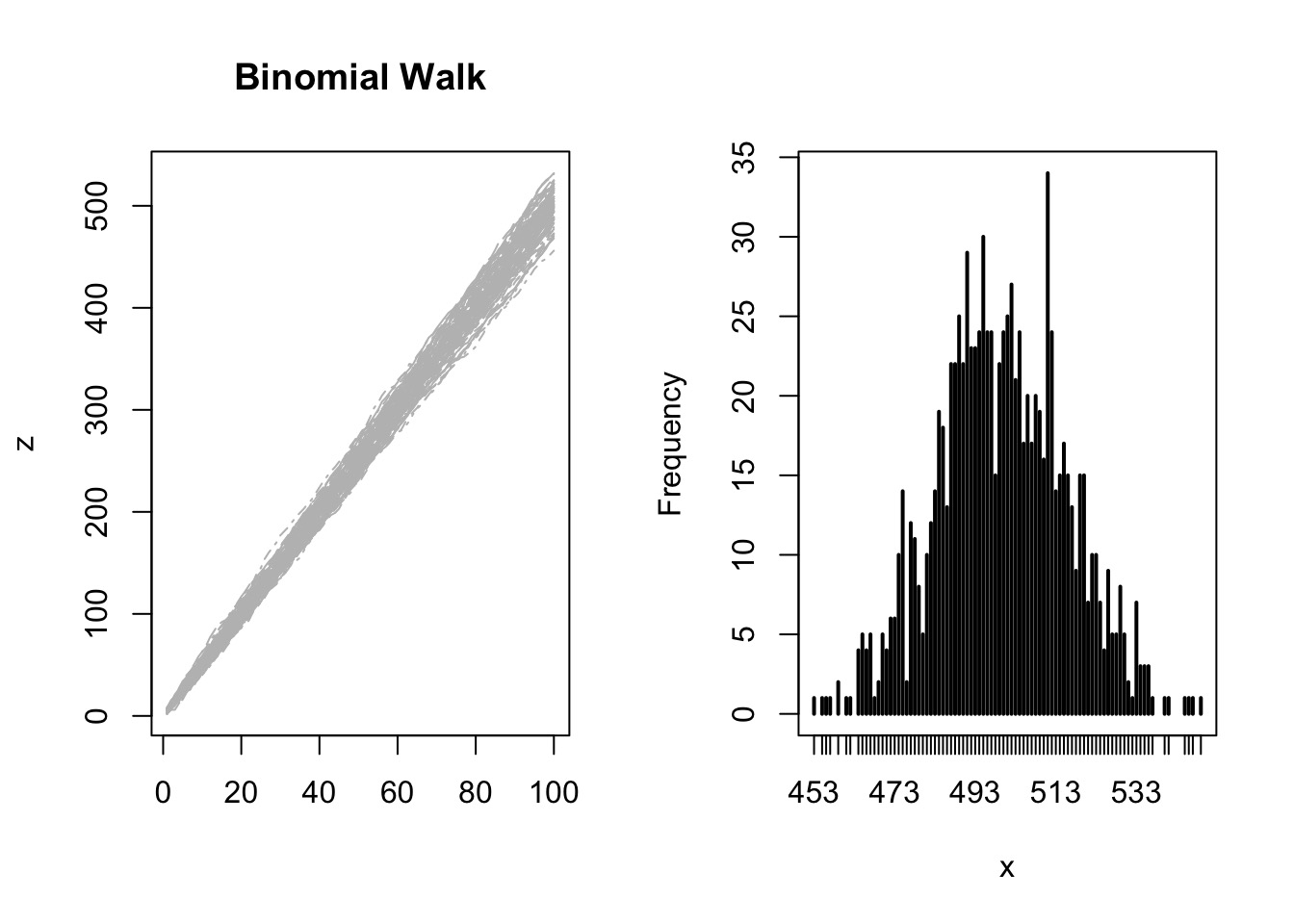
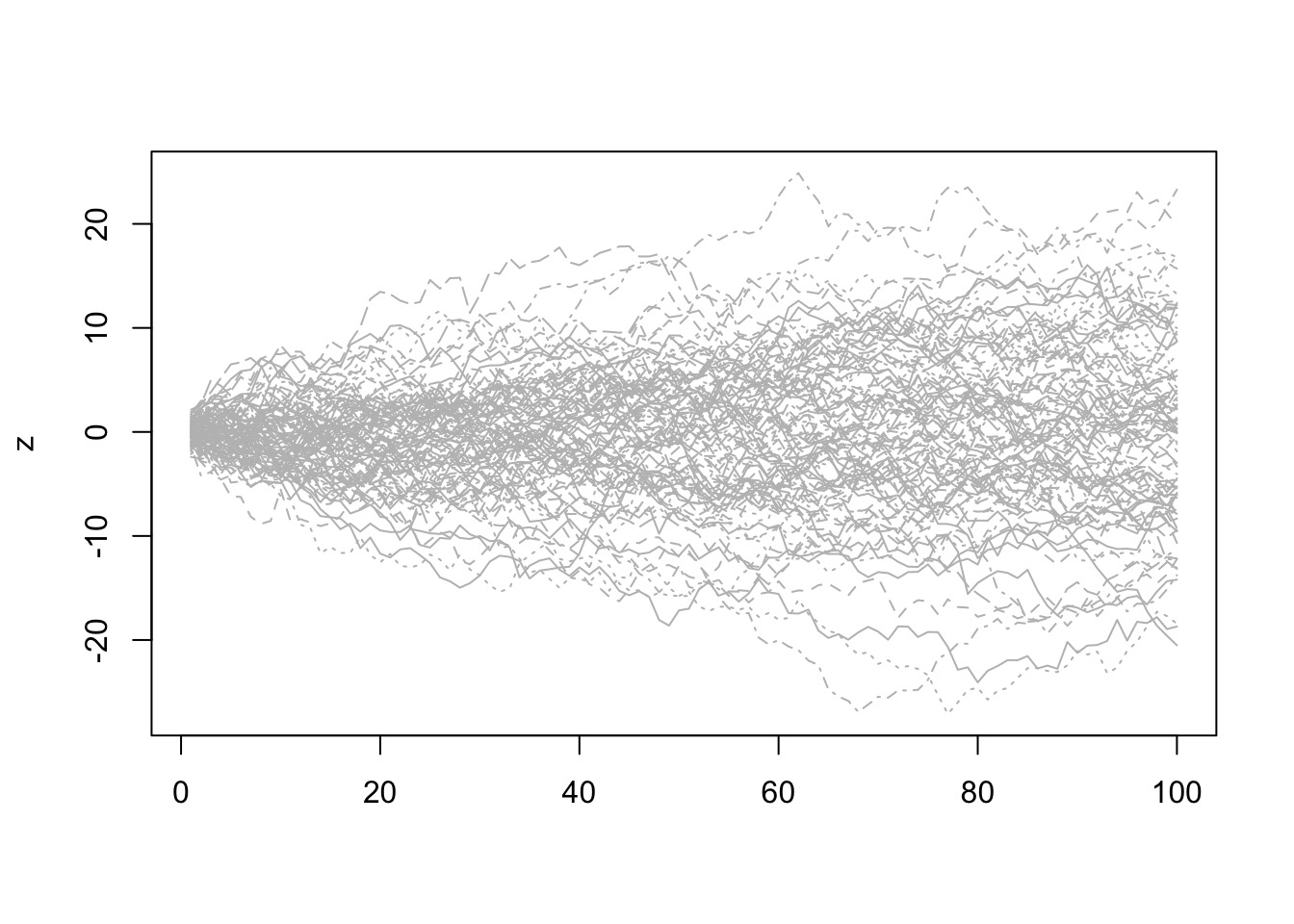
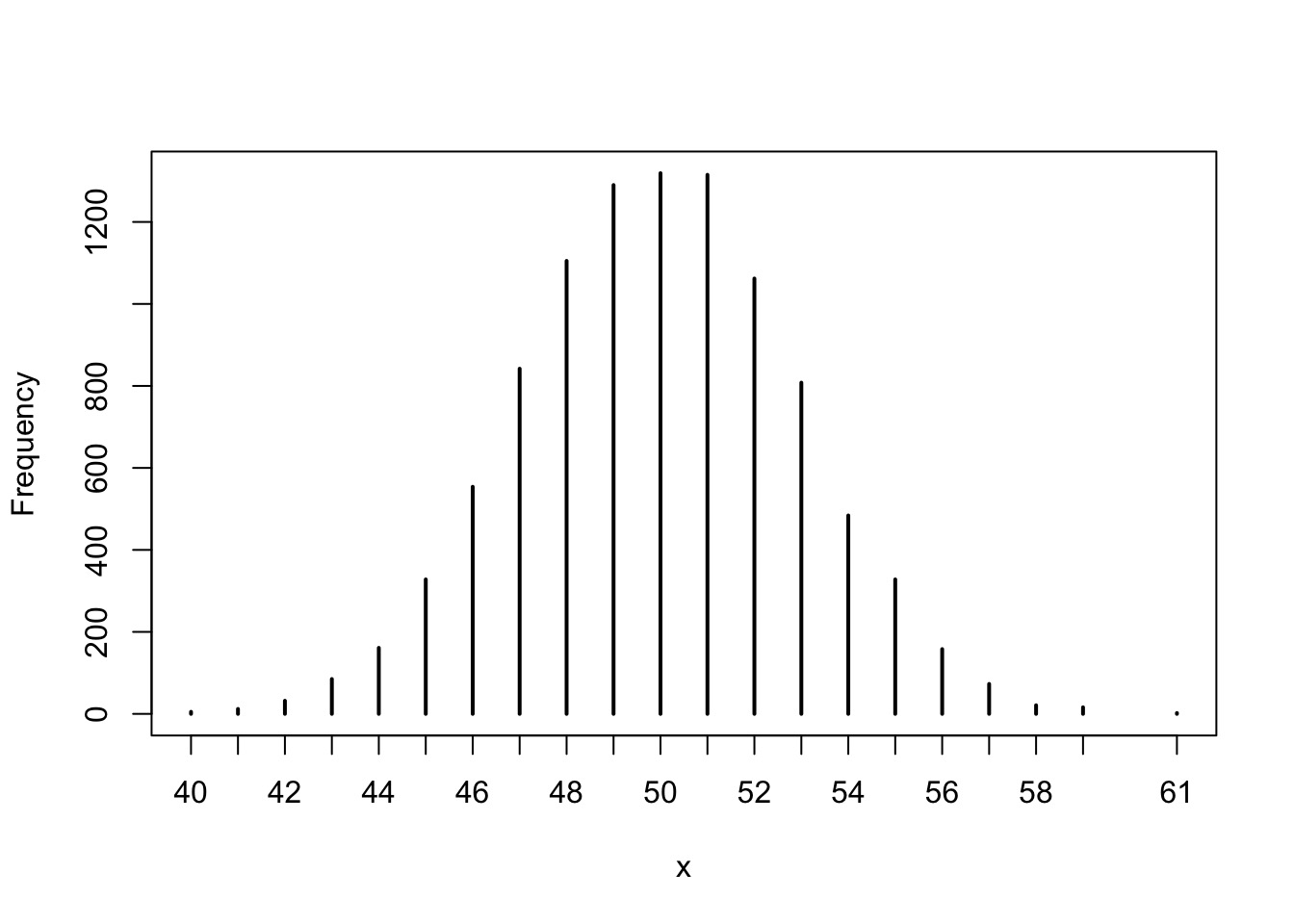
Try it: the Central Limit Theorem

library(rethinking)
simplehist(replicate(10000, sum(rbeta(100,1,1))))
So, how do we build models?

  1. Identify response

  2. Determine likelihood (distribution of error of response)

  3. Write equation(s) describing generation of predicted values

  4. Assign priors to parameters

Our Previous Model

Likelihood:
\(w \sim Binomial(6, size=9, prob = prob)\)

Prior:
\(prob \sim Uniform(0,1)\)

A Normal Model

Likelihood:
\(y_i \sim Normal(\mu, \sigma)\)

Prior:
\(\mu \sim Normal(0,1000)\)
\(prob \sim U(0,50)\)

A Model of a Mean

data(Howell1)
Howell1_Adult <- Howell1 %>% 
  filter(age >= 18)

Height-Weight relationships of the !Kung San

Our Model

Likelihood:
\(h_i \sim Normal(\mu, \sigma)\)

Prior:
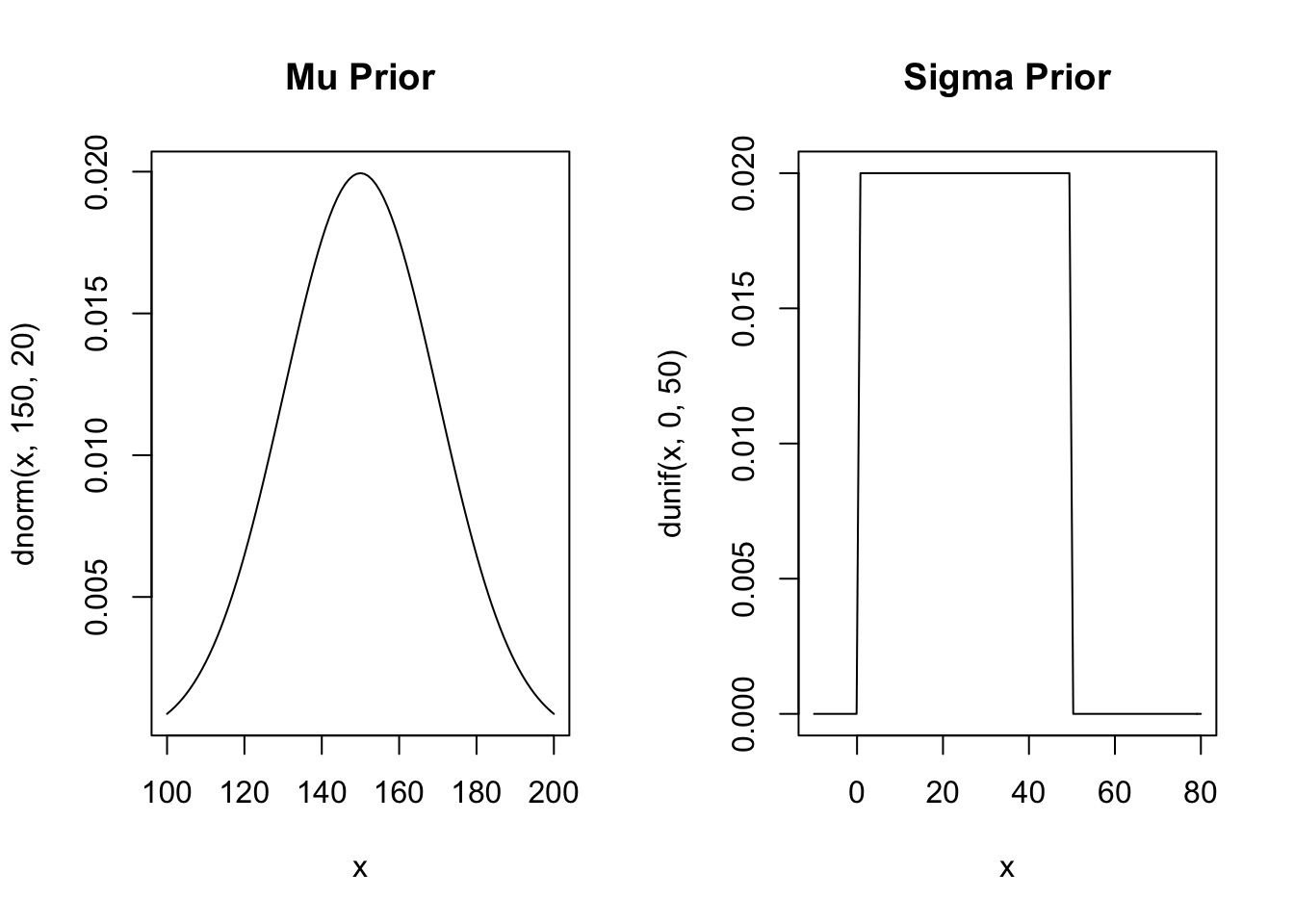
\(\mu \sim Normal(150, 20)\) From the data
\(\sigma \sim U(0,50)\) Wide range of possibilities

Priors

Grid Sampling

# Make the grid
grid <- crossing(mu = seq(140, 160, length.out=200),
                 sigma = seq(4, 9, length.out=200)) %>%

#Calculate the log-likelihoods for each row  
  group_by(1:n()) %>%
  mutate(log_lik = sum(dnorm(Howell1_Adult$height, mu, sigma, log=TRUE))) %>%
  ungroup() %>%

# Use these and our posteriors to get the numerator
# of Bayes theorem
  mutate(numerator = log_lik + 
           dnorm(mu, 150, 20, log=TRUE) +
           dunif(sigma, 0,50, log=TRUE)) %>%

#Now calculate the posterior (approximate)  
  mutate(posterior = exp(numerator - max(numerator)))

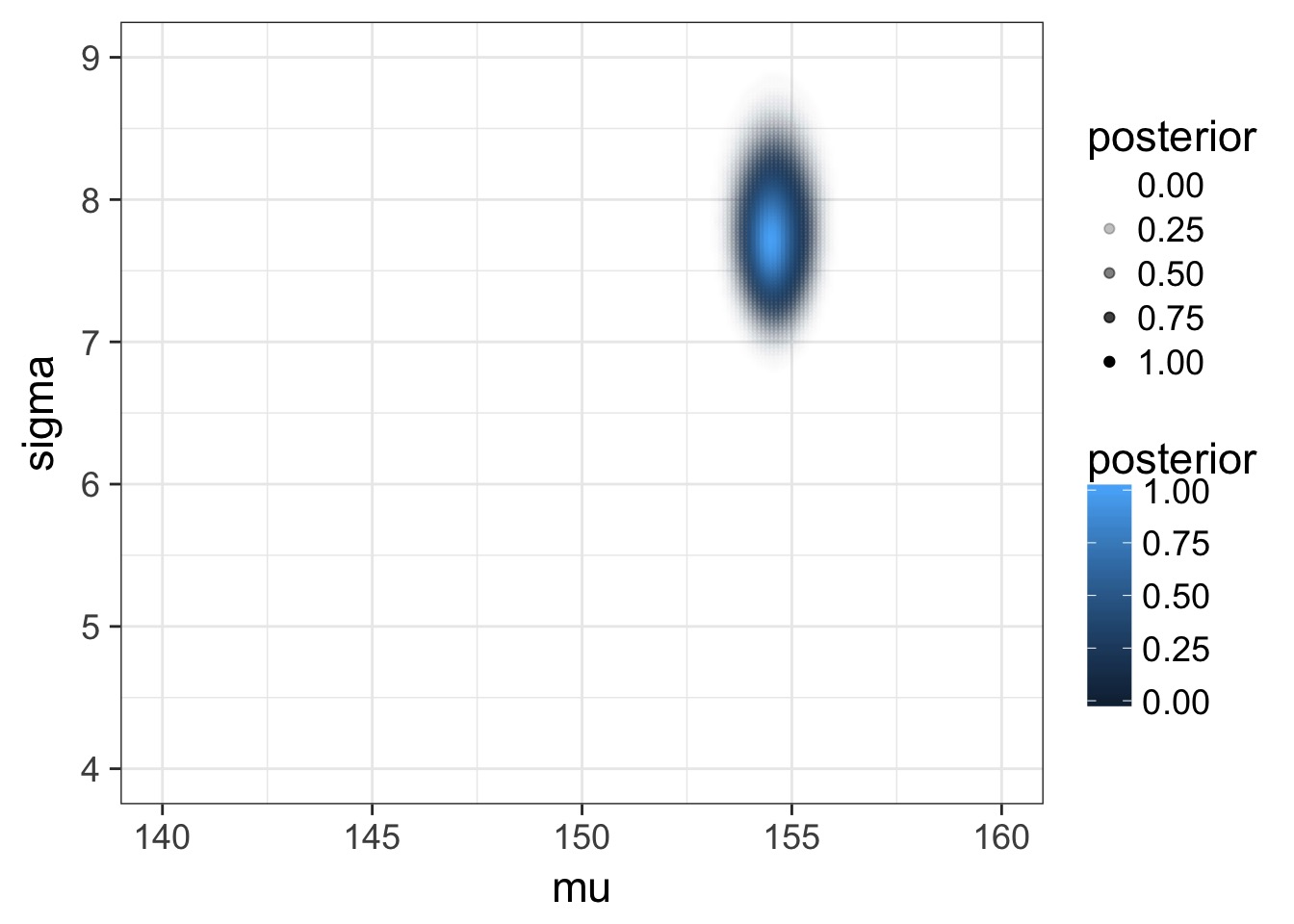
Posterior

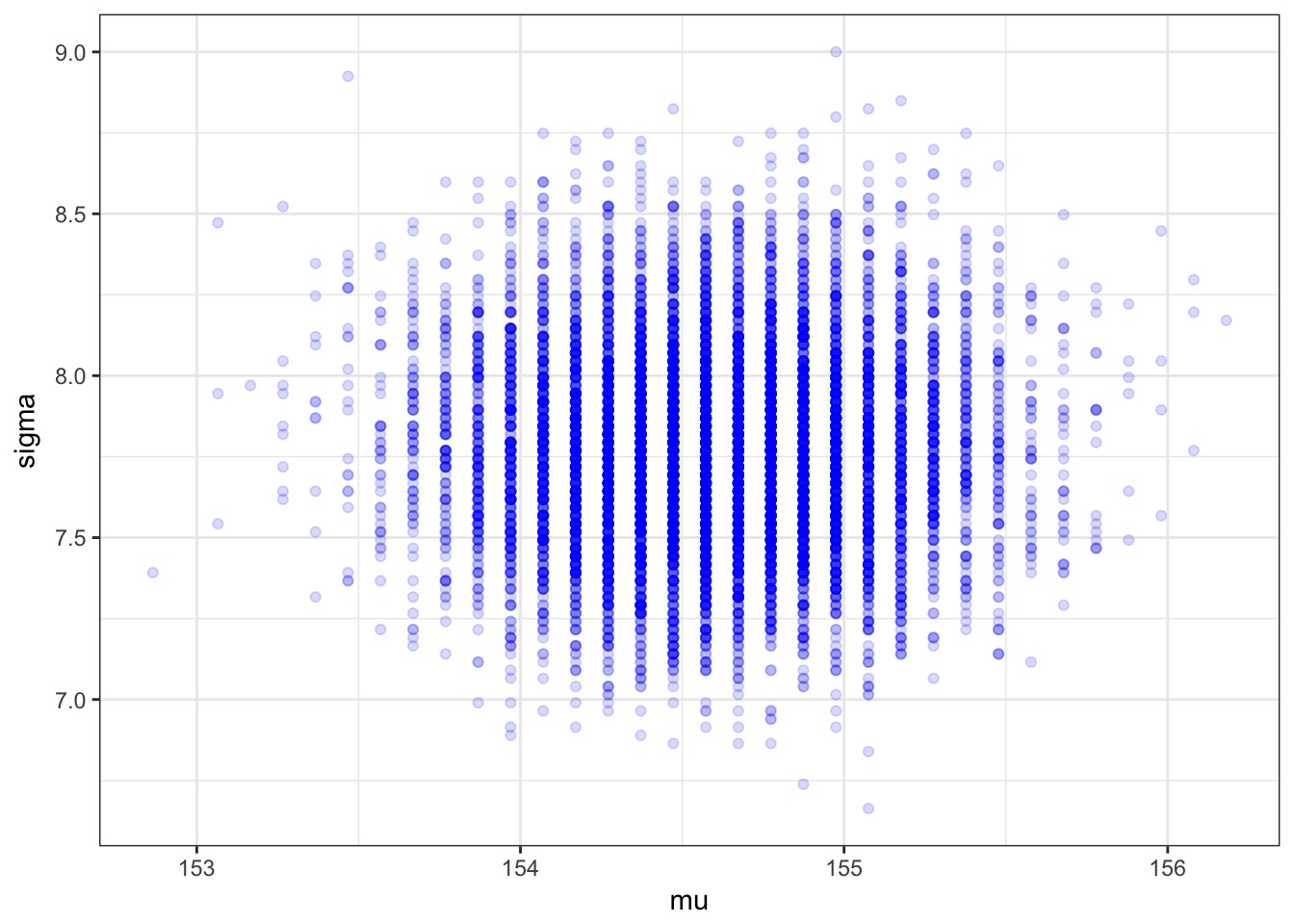
Posterior from a Sample

Or, let’s Reconceptualize With a Model

Likelihood:
\(h_i \sim Normal(\mu, \sigma)\)    height ~ dnorm(mu, sigma)

Prior:
\(\mu \sim Normal(150, 20)\)    mu ~ dnorm(150, 200)
\(\sigma \sim U(0,50)\)    sigma ~ dunif(0,50)

Feed the Model to Maximum A Posterior Approximation

mean_mod <- alist(
  #likelihood
  height ~ dnorm(mu, sigma),
  
  #priors
  mu ~ dnorm(150, 20),
  sigma ~ dunif(0,50)
)

mean_fit <- map(mean_mod,
                data = Howell1_Adult)

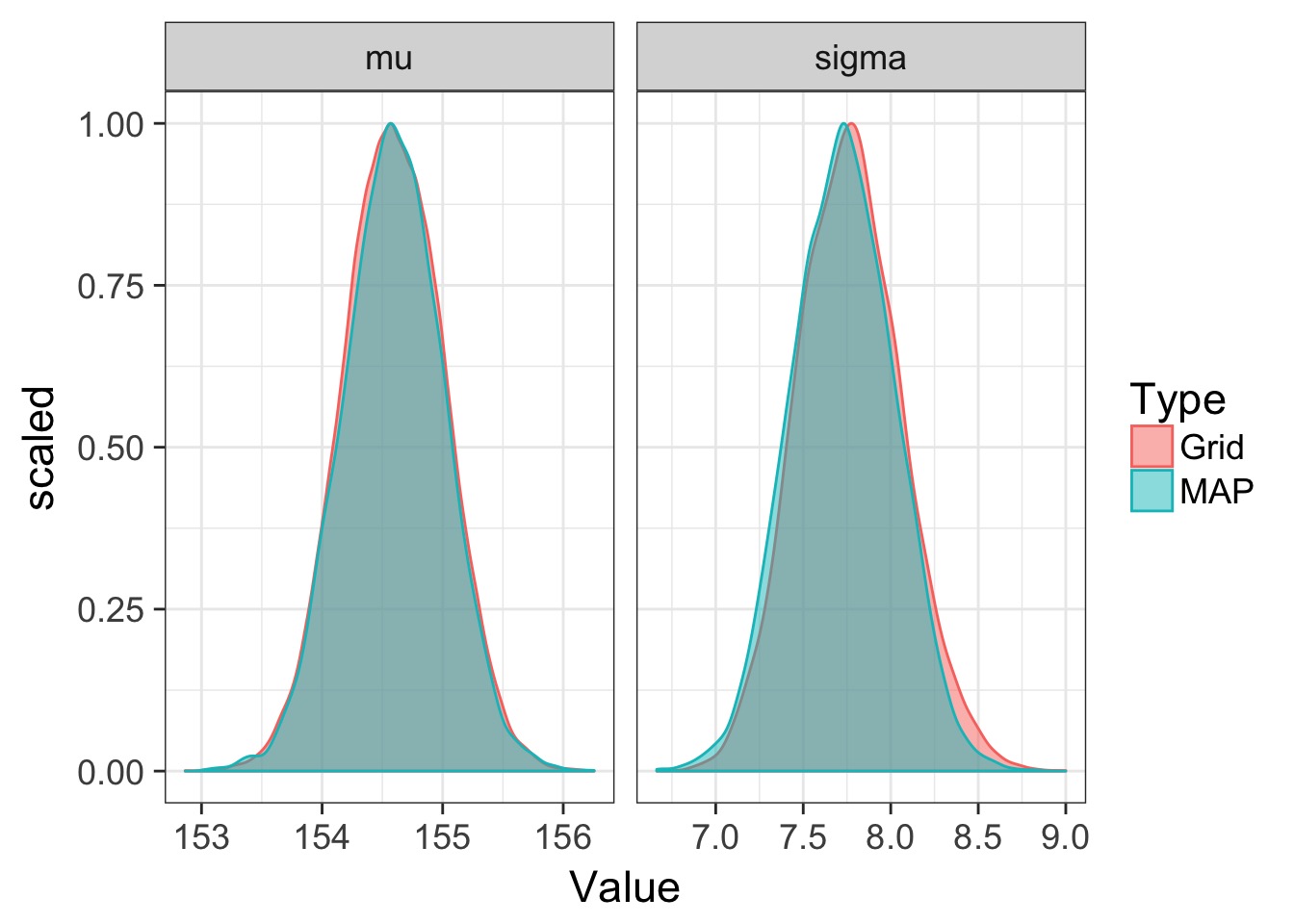
Compare map to grid

Adding a Predictor

  1. Identify response

  2. Determine likelihood (distribution of error of response)

  3. Write equation(s) describing generation of predicted values

  4. Assign priors to parameters

Now Mean Changes with predictor

Likelihood:
\(h_i \sim Normal(\mu_i, \sigma)\)

Data Generating Process
\(\mu_i = \alpha + \beta x_i\)

Prior:
\(\alpha \sim Normal(178, 100)\)   Reasonable Range from data
\(\beta \sim Normal(0, 10)\)   Weakly Informative
\(\sigma \sim U(0,50)\)  Wide range of possibilities

Our Linear Model

weight_mod <- alist(
  #likelihood
  height ~ dnorm(mu, sigma),
  
  #Data generating process
  mu <- alpha + beta * weight,
  
  #priors
  alpha ~ dnorm(178, 100),
  beta ~ dnorm(0, 10),
  sigma ~ dunif(0,50)
)

weight_fit <- map(weight_mod,
                data = Howell1_Adult)

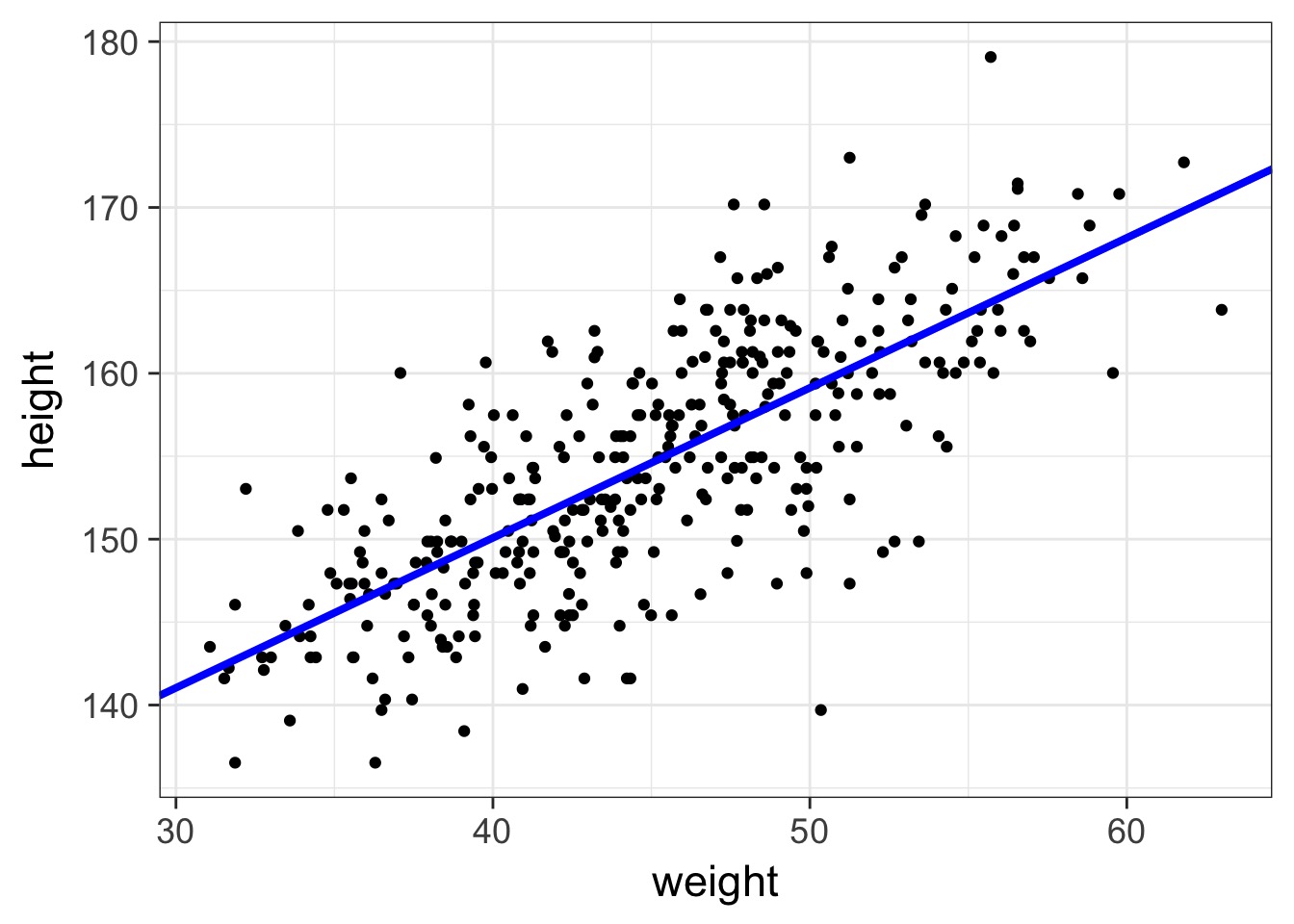
The fit

So, what do we do with a fit model?

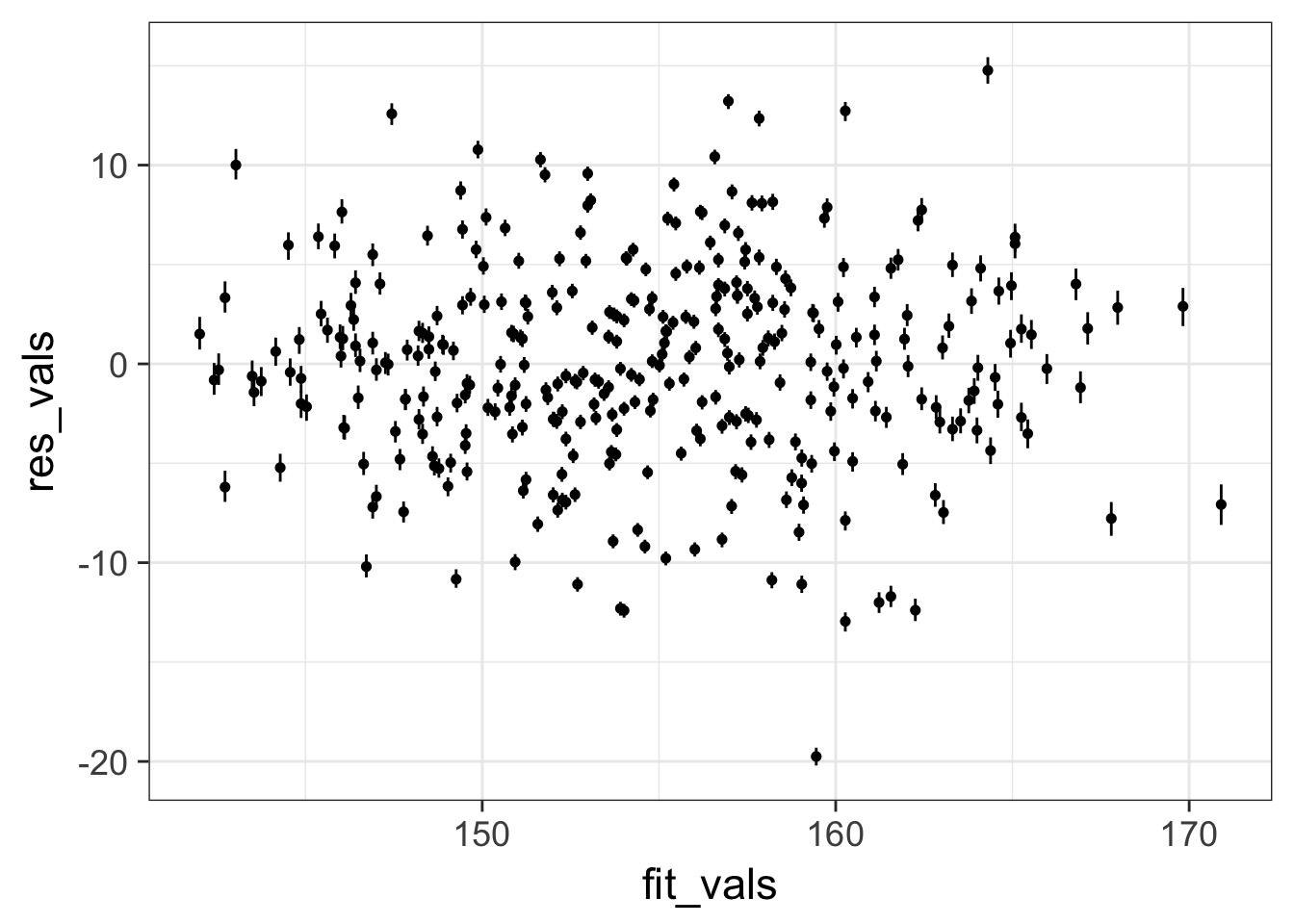
  1. Evaluate model assumptions

  2. Evaluate model estimates and meaning

  3. Assess uncertainty in fit

  4. Assess uncertainty in prediction

Sampling from the Posterior Predictions

We use link to extract from the link (prediction) function:

fit_vals_sim <- link(weight_fit, n = 1e4, refresh=0)

dim(fit_vals_sim)
[1] 10000   352
fit_vals <- apply(fit_vals_sim, 2, median)
fit_pi <- apply(fit_vals_sim, 2, HPDI, prob=0.8)

QQ, etc…

res_vals <- Howell1_Adult$height - fit_vals

qqnorm(res_vals); qqline(res_vals)
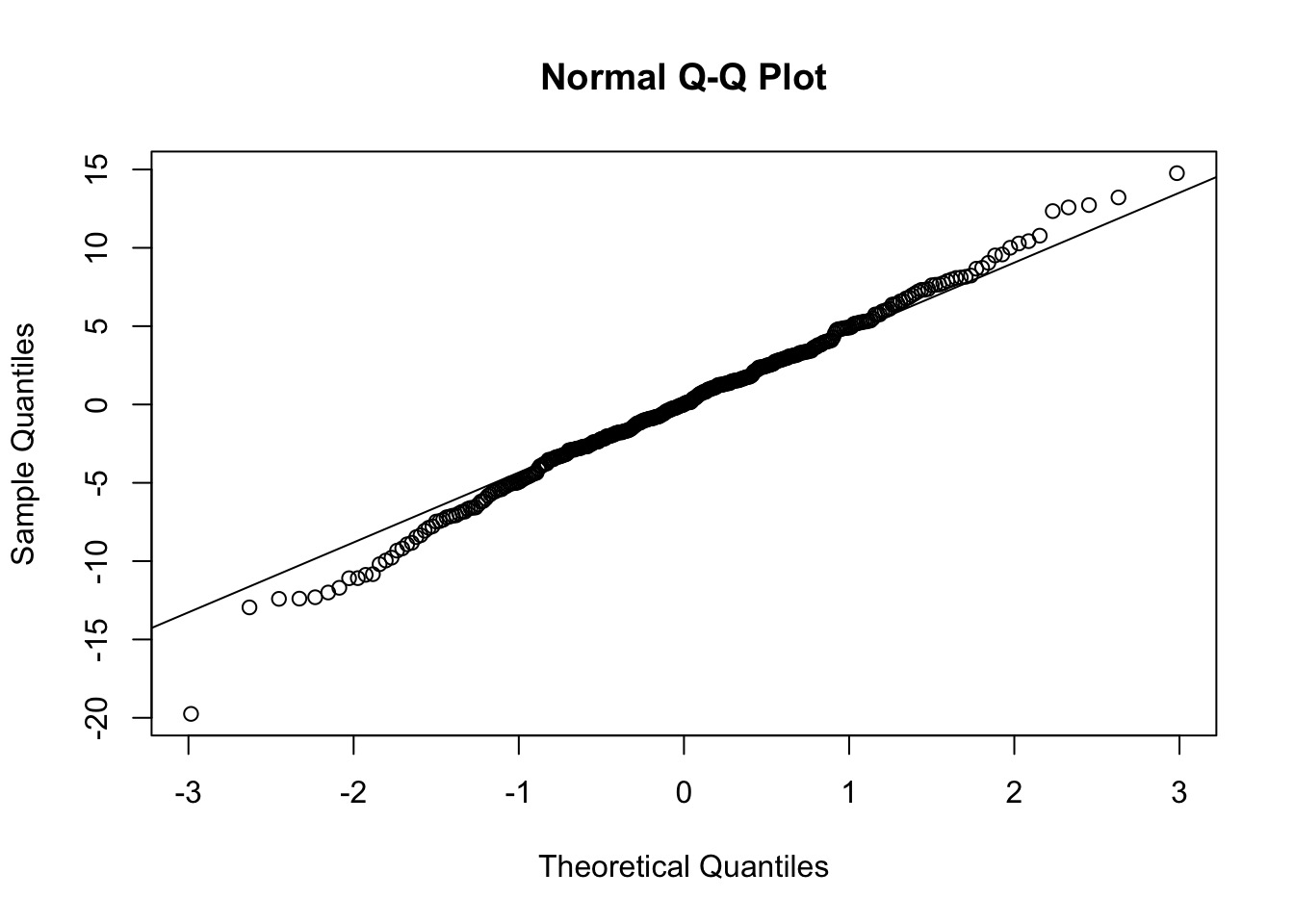
Observed - Fitted
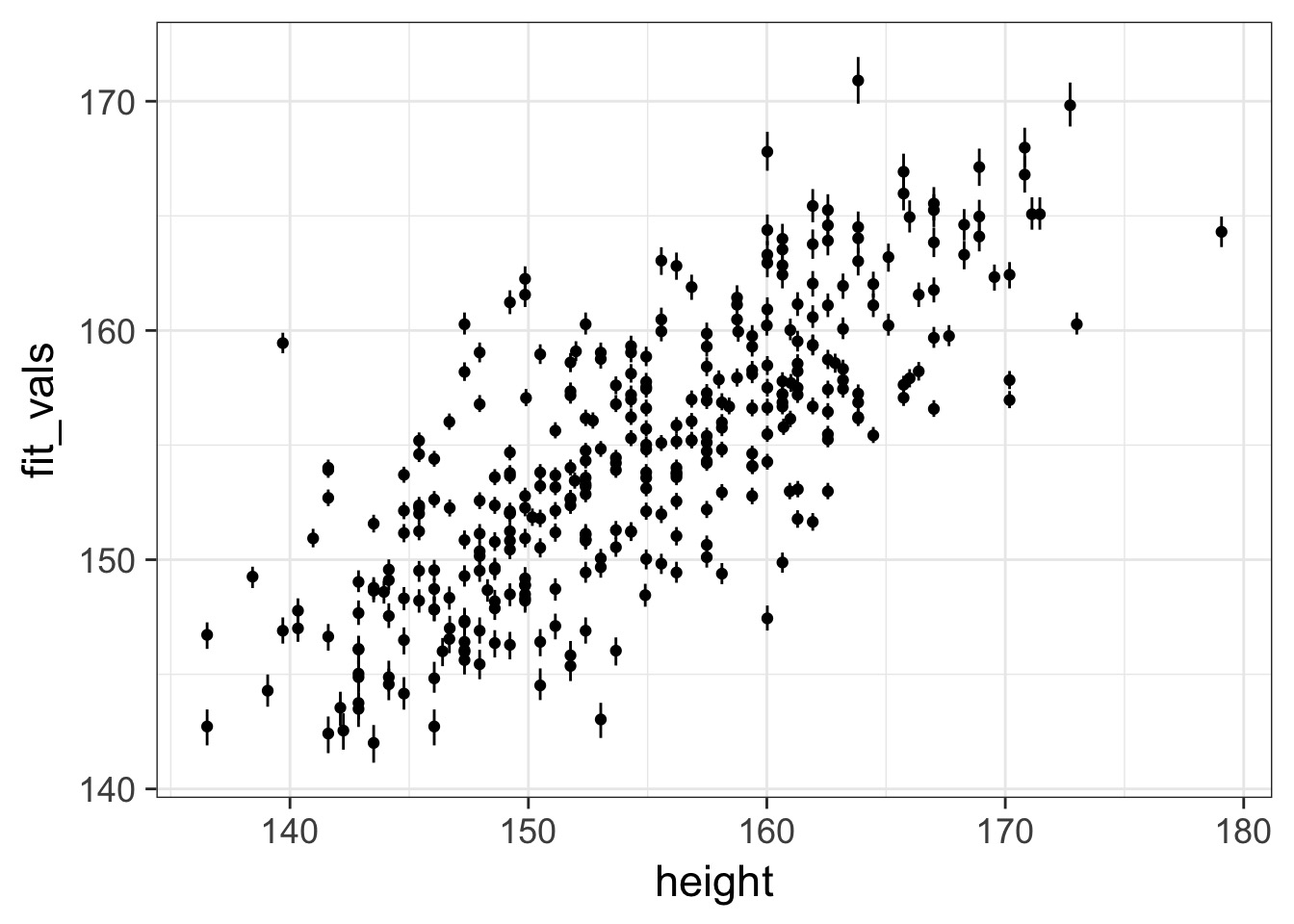
Fit-Residual
Model Results
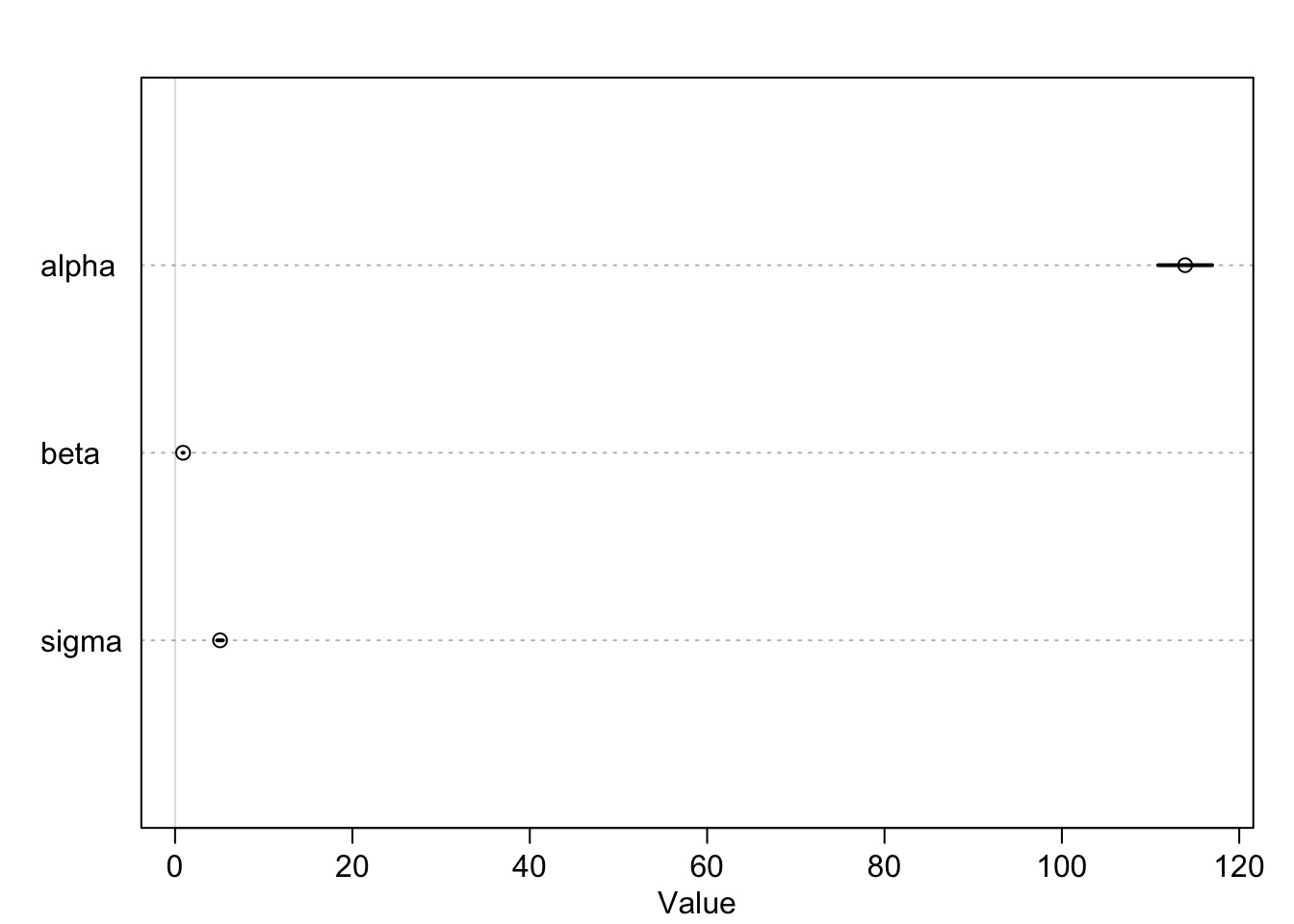
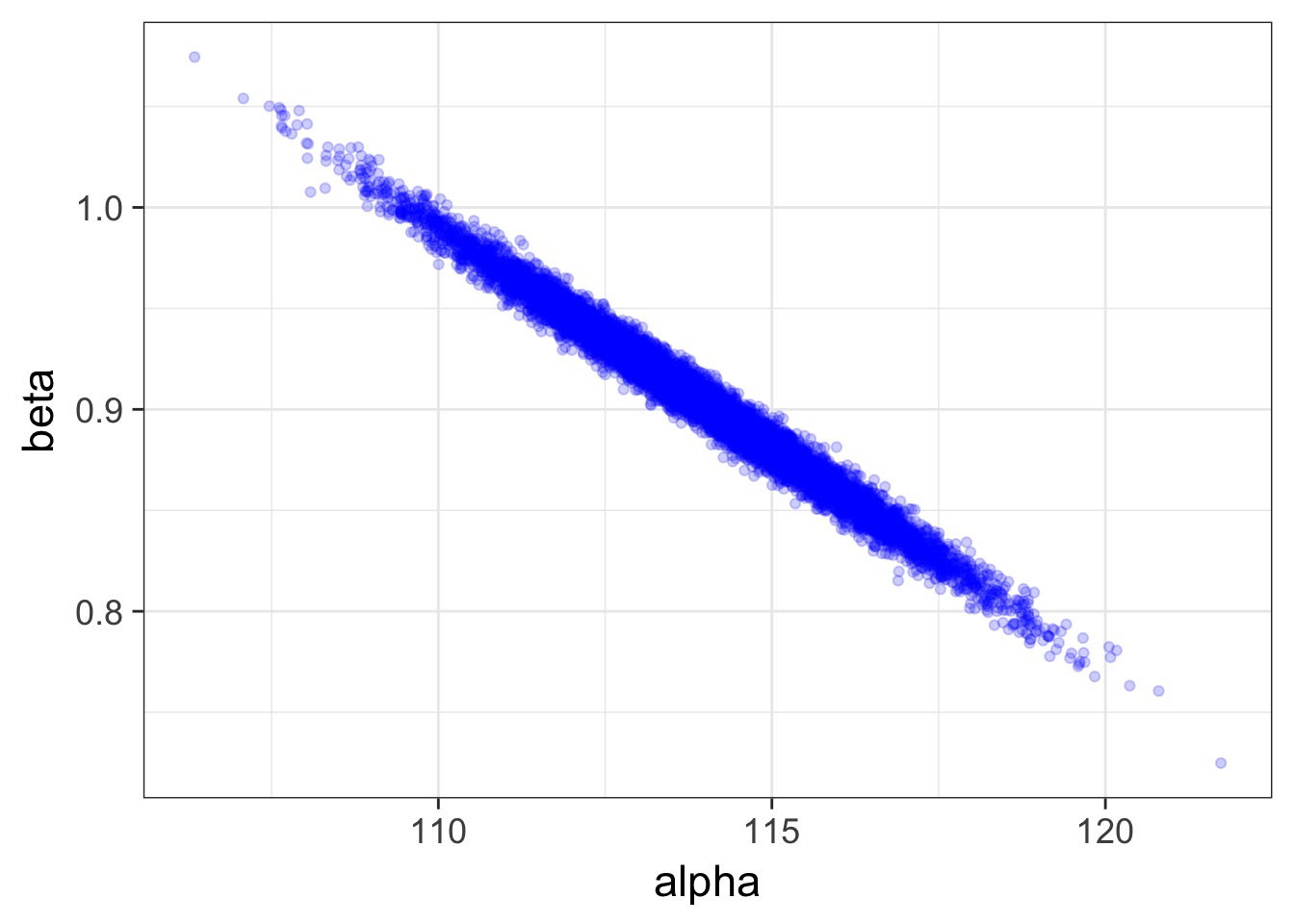
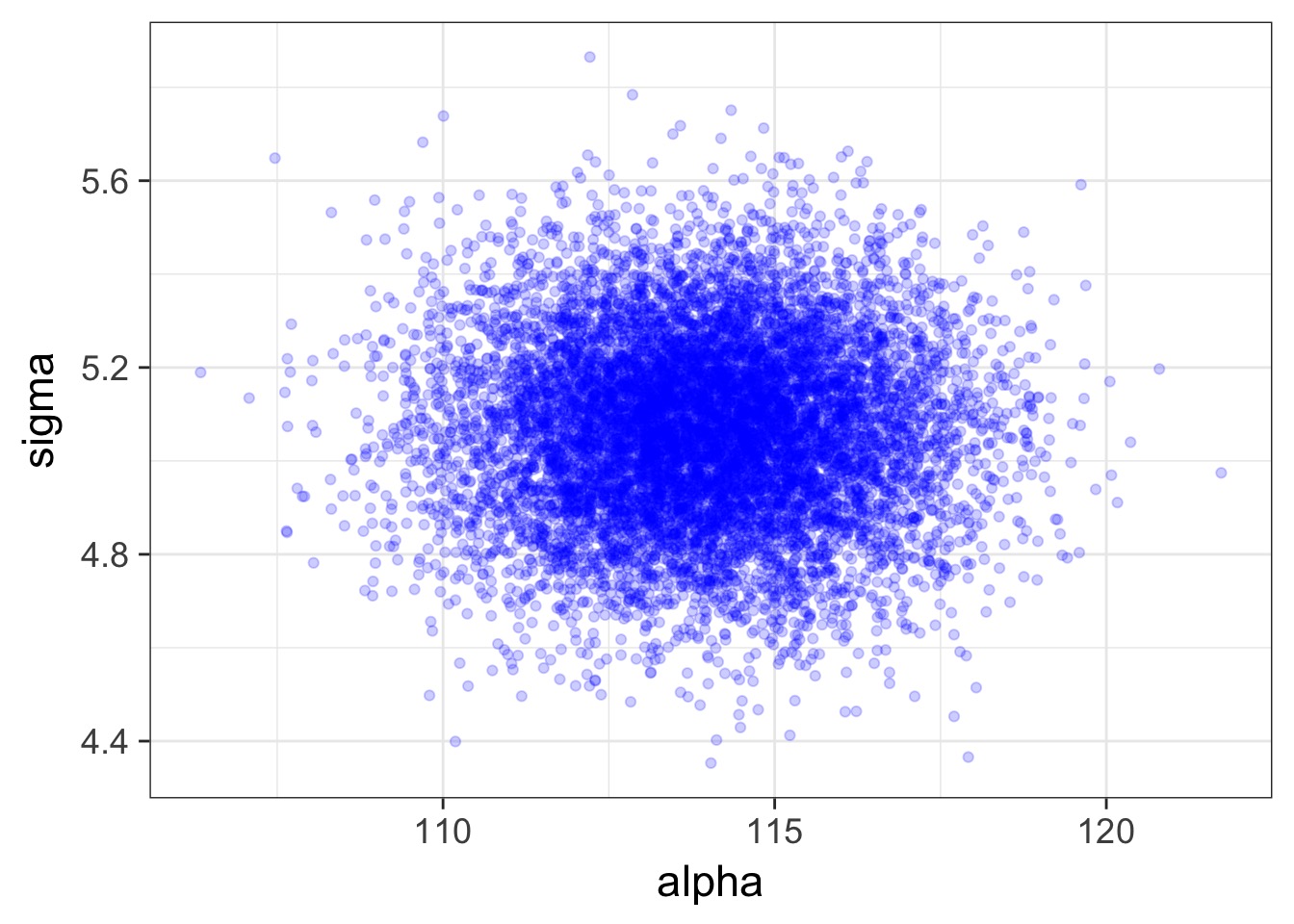
precis(weight_fit, cor=TRUE)
        Mean StdDev   5.5%  94.5% alpha  beta sigma
alpha 113.90   1.91 110.86 116.95  1.00 -0.99     0
beta    0.90   0.04   0.84   0.97 -0.99  1.00     0
sigma   5.07   0.19   4.77   5.38  0.00  0.00     1
  • Are these meaningful?
  • Should you standardize predictors for a meaningful intercept?
  • Is this the right interval?

Model Results

Sampling from the Posterior Distribution

post <- extract.samples(weight_fit, 1e4)

head(post)
     alpha      beta    sigma
1 115.2085 0.8735581 5.466552
2 109.6589 0.9952665 5.091604
3 115.8158 0.8565583 5.063665
4 112.9260 0.9288220 5.235847
5 112.9272 0.9191604 5.057091
6 114.7322 0.8861771 5.331461

Posterior!

Posterior!

How Well Have we Fit the Data?
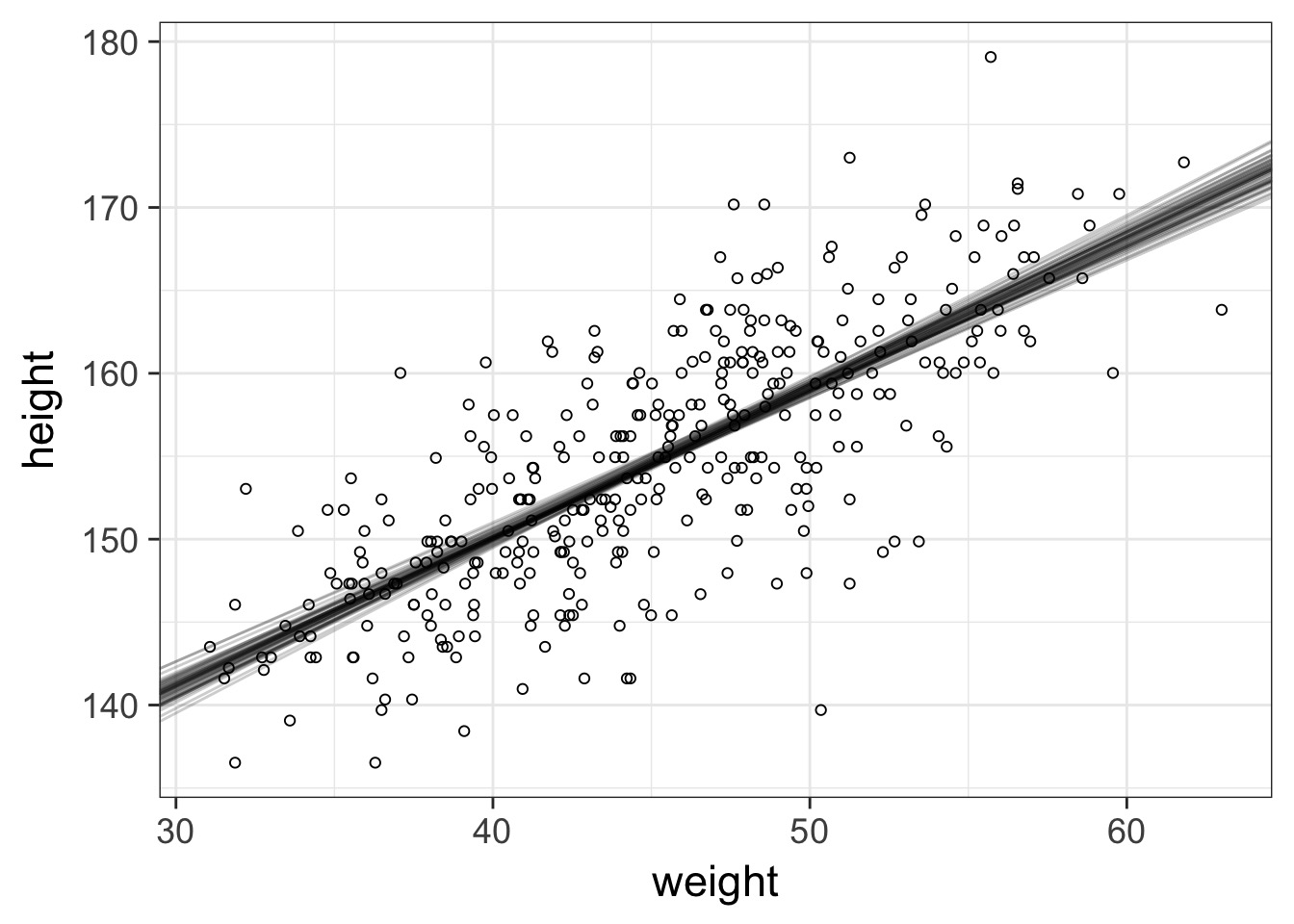
ggplot() +
  
  #the data
  geom_point(data=Howell1_Adult, 
             mapping=aes(x=weight, y=height), pch=1) +
  
  #simulated fits from the posterior
  geom_abline(data=post[1:50,], 
              mapping=aes(slope=beta, intercept=alpha), alpha=0.2) +
  
  theme_bw(base_size=17)

How Well Have we Fit the Data?

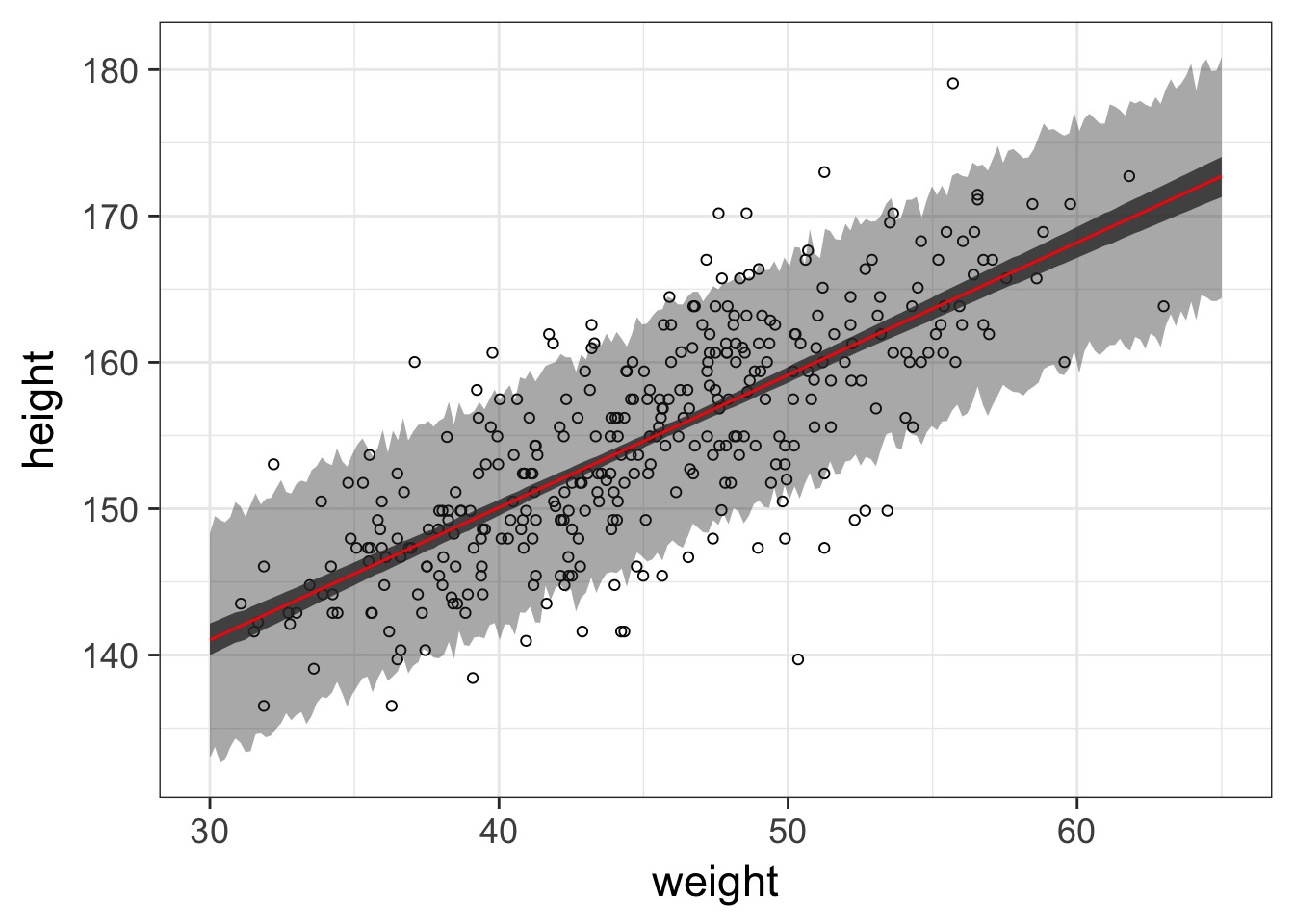
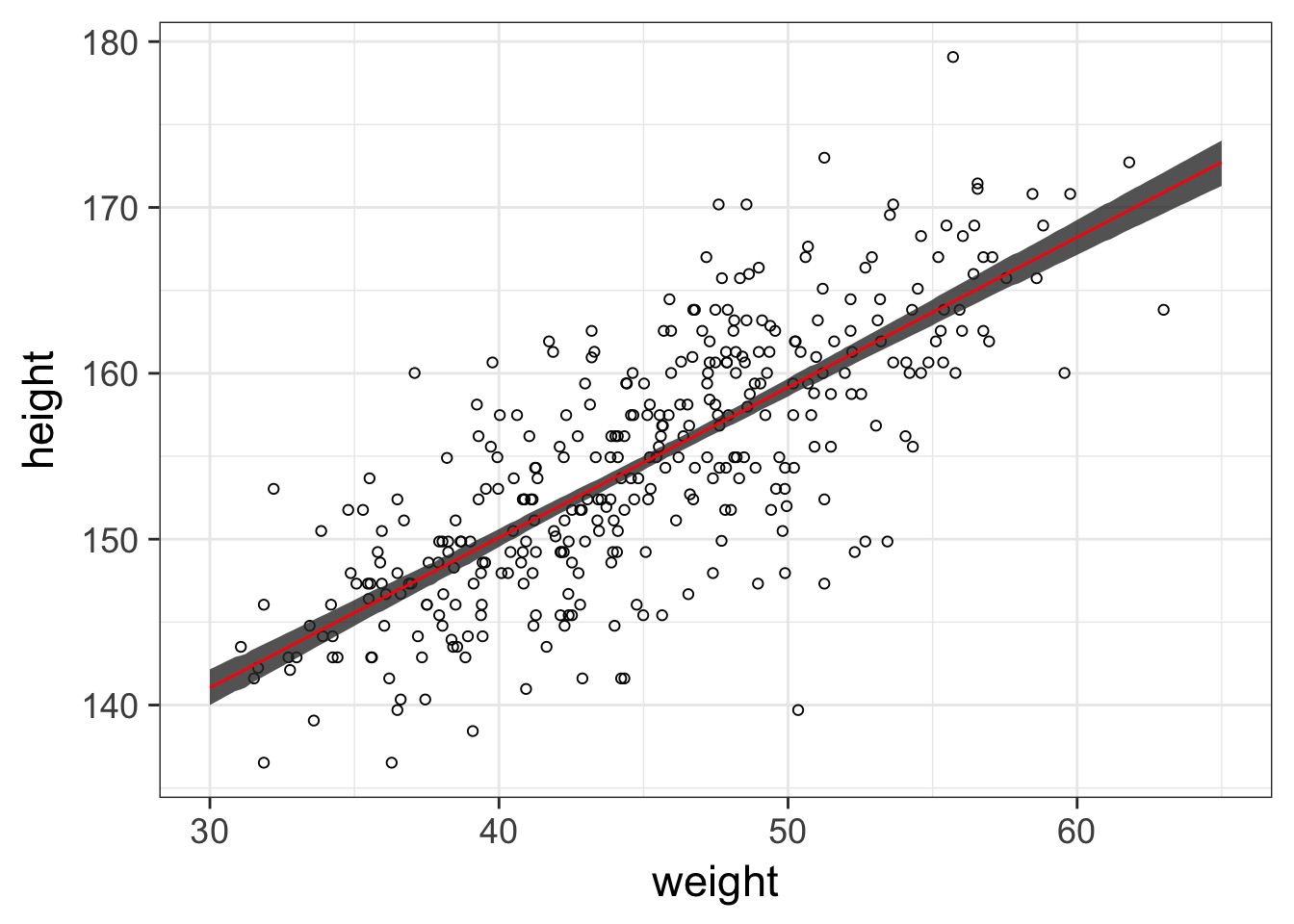
What about with fit intervals?

#1) Make a fake data frame over the relevant range
pred_df <- data.frame(weight=seq(30,65, length.out=200))

#2) Get the fit values & interval
pred <- link(weight_fit, data=pred_df, refresh=0)
pred_hpdi <-  apply(pred, 2, HPDI)

#3) Put it all back together and plot
pred_df <- mutate(pred_df, 
                  height = apply(pred, 2, mean),
                  lwr_fit = pred_hpdi[1,],
                  upr_fit = pred_hpdi[2,])

What about with fit intervals?

geom_line and geom_ribbon for plotting
What about prediction intervals?

#1) Get the posterior prediction interval
pred_full <- sim(weight_fit, data=pred_df, refresh=0)
full_hpdi <-  apply(pred_full, 2, HPDI)

#2) Put it all back together and plot
pred_df <- mutate(pred_df, 
                  lwr_pred = full_hpdi[1,],
                  upr_pred = full_hpdi[2,])

Prediction Interval


Polynomial Regression and Standardization

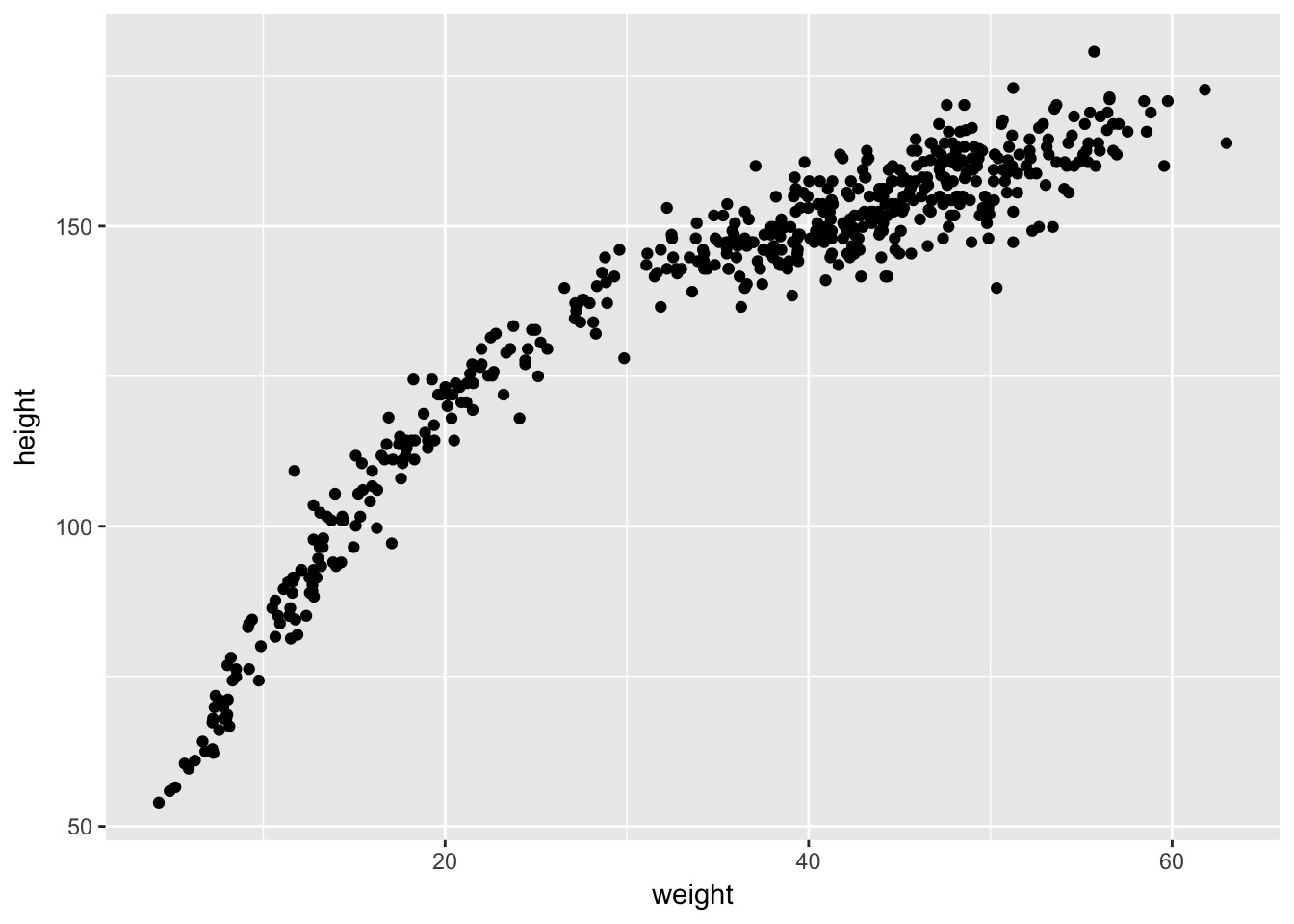
The Actual Data

This is not linear

A nonlinear Model

Likelihood:
\(h_i \sim Normal(\mu_i, \sigma)\)

Data Generating Process
\(\mu_i = \alpha + \beta_1 x_i + \beta_2 x_i^2 + \beta_3 x_i^3\)

Prior:
\(\alpha \sim Normal(178, 100)\)
\(\beta_j \sim Normal(0, 10)\)
\(\sigma \sim U(0,50)\)

Before fitting this, Standardize!

  • Standardizing a predictor aids in fitting
    • Scale issues of different variables

  • Standardizing yields comparable coefficients

  • You don’t have to
    • But if you encounter problems, it’s a good fallback

Our Model

full_height_mod <- alist(
  #likelihood
  height ~ dnorm(mu, sigma),
  
  #Data generating process
  mu <- alpha + 
    beta1 * weight.s + 
    beta2 * weight.s2 +
    beta3 * weight.s3,
  
  #priors
  alpha ~ dnorm(178, 100),
  beta1 ~ dnorm(0, 10),
  beta2 ~ dnorm(0, 10),
  beta3 ~ dnorm(0, 10),
  sigma ~ dunif(0,50)
)

Making variables and Fitting

Howell1 <- mutate(Howell1,
                  weight.s = (weight-mean(weight))/sd(weight),
                  weight.s2 = weight.s^2,
                  weight.s3 = weight.s^3)

full_height_fit <- map(full_height_mod,
                       data = Howell1)

Exercise

  1. Fit this nonlinear model

  2. Assess it

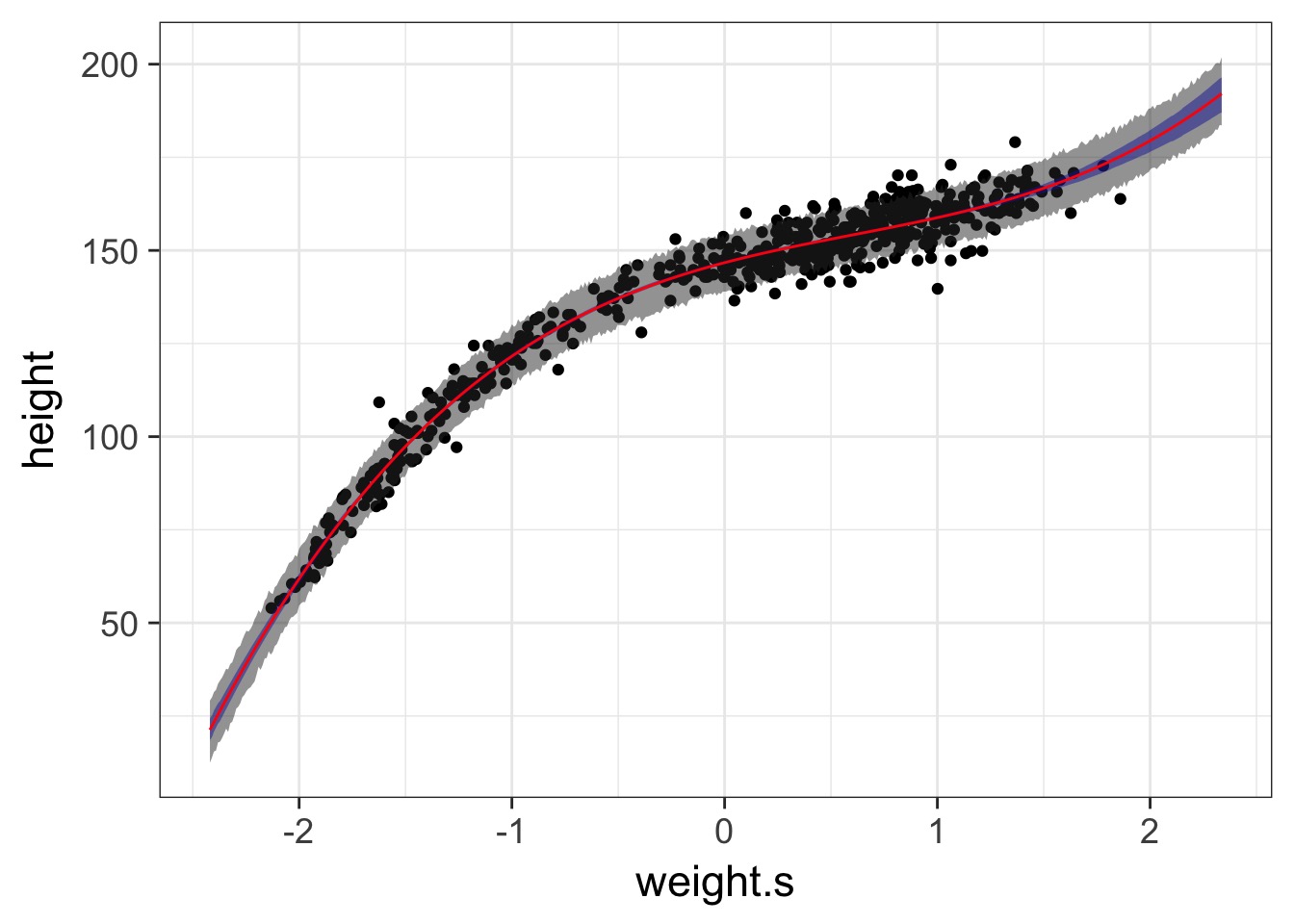
  3. Plot the fit and error
    • Feel free to use link or the posterior to plot fit error

Solution

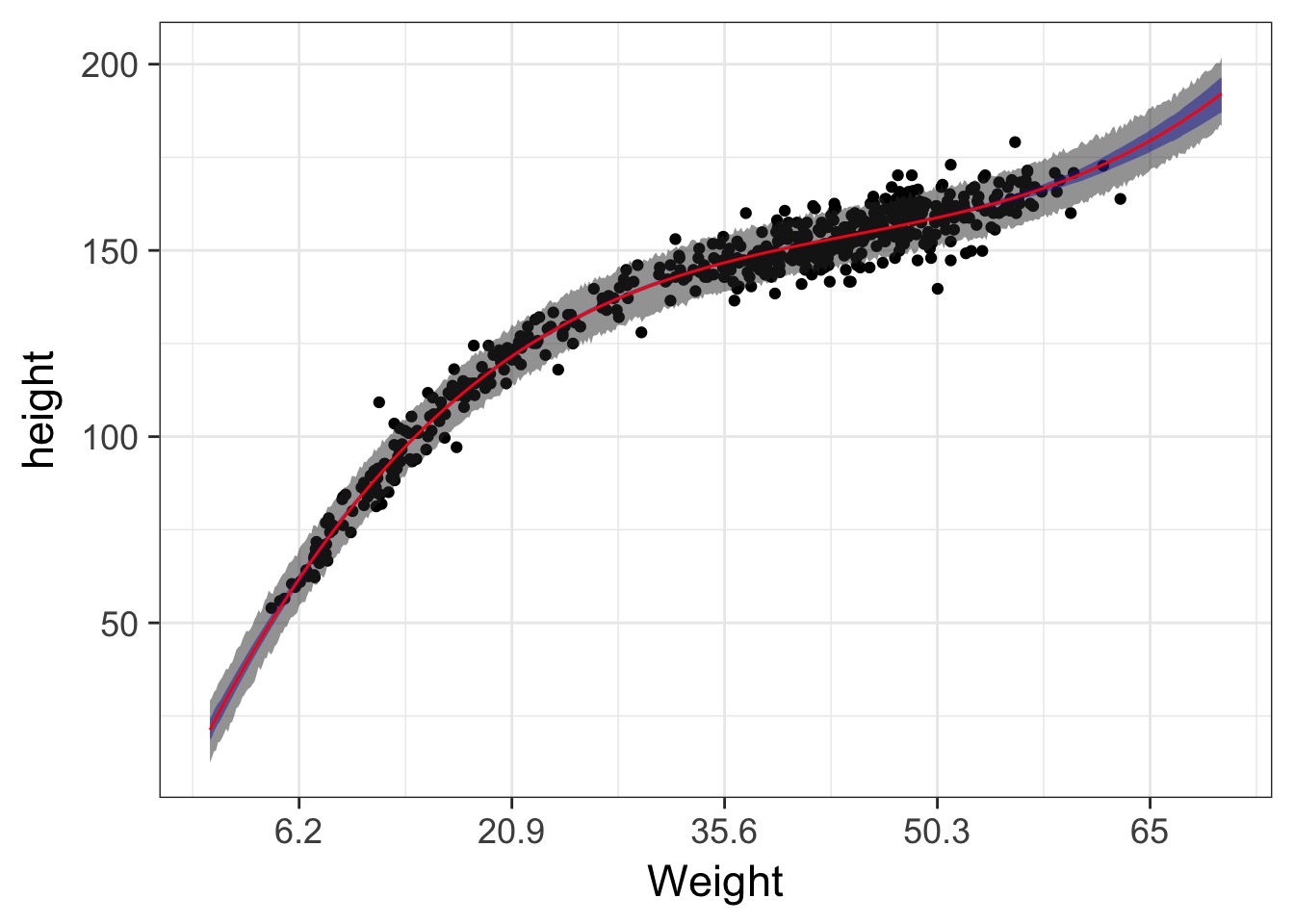
I hate that x axis

pred_plot +
  scale_x_continuous(label = function(x) 
    round(x*sd(Howell1$weight) + mean(Howell1$weight),1)) +
  xlab("Weight")